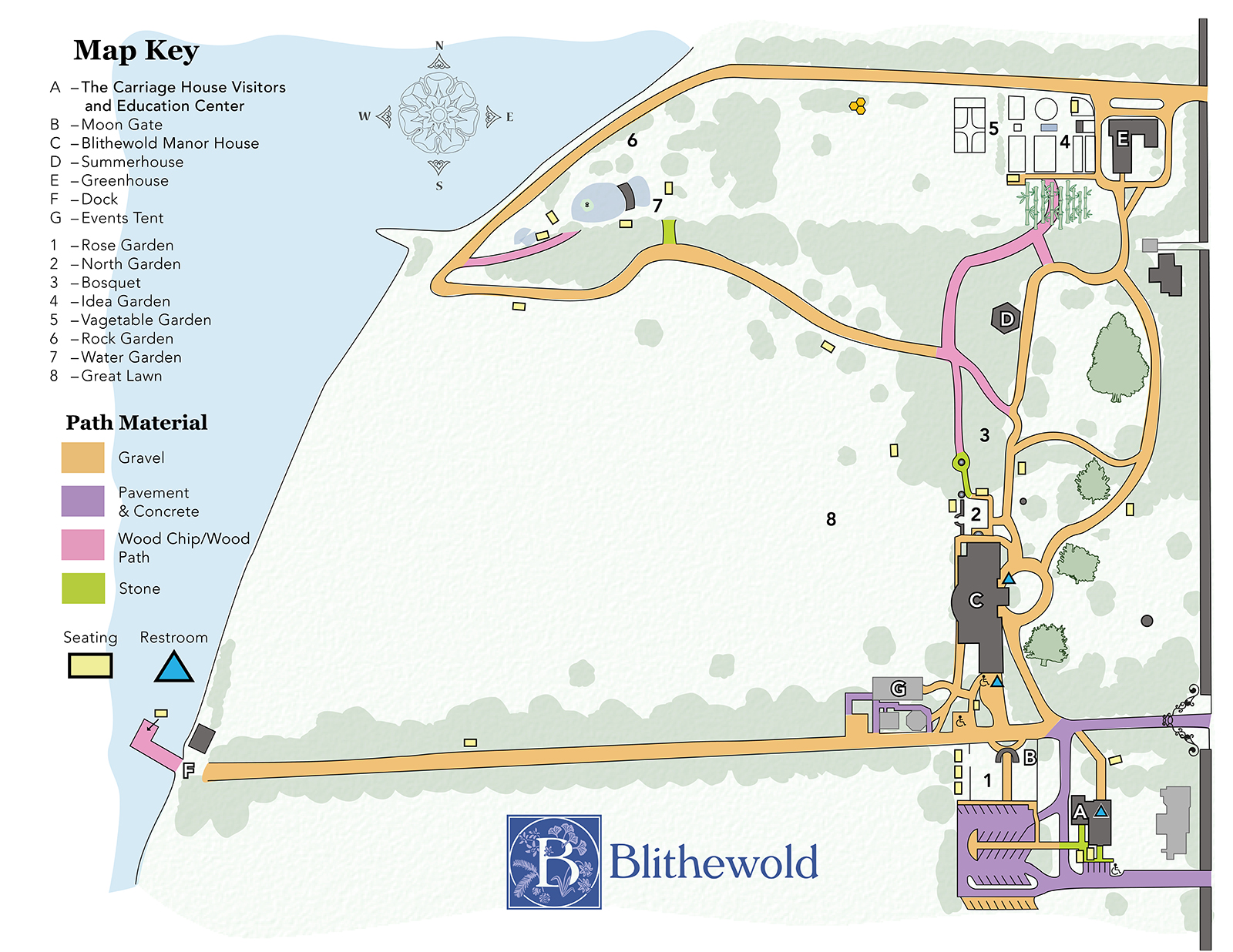
Garden Map


50 Specimen Trees at Blithewold:

1. Halesia carolina Carolina Silverbell A small tree native to the southeastern US with white bell-like flowers in the spring followed by fruit pods that resemble hops. Useful as an understory or edge tree; tolerates dry shade. Zone 4

2. Acer saccharum Sugar Maple Fall color of this large shade tree is among the best of New England’s natives. Sugar maples are tapped for sap in early spring; approximately 32 gallons of sap yields one gallon of maple syrup.

3. Magnolia stellata Star Magnolia Planted in 1962, this magnolia has white, fragrant, star-like flowers in April. Plant this tree in a cold pocket to delay flowering, which will prevent frost damage to the delicate petals. Full sun, zone 4

4. Sciadopitys verticillata Japanese Umbrella Pine Leaves of this very formal Japanese native are borne in umbrella-like clusters. Slow-growing to 30’, it does not get as big as our native conifers.

5. Tsuga canadensis ‘Sargentii’ Sargent’s Weeping Hemlock This form of the eastern hemlock is grafted onto a standard hemlock stem for height and full display of the branches. Blithewold’s tree was planted in 1910, and we have been able to protect it from hemlock wooly adelgid.

6. Metasequoia glyptostroboides Dawn Redwood Along with the larch and swamp cypress, this is a deciduous conifer. In 1941, fossils of this tree were found before the tree was known to exist. That same year, plant explorers discovered live specimens in central China. With beautiful form and attractive bark, this fast-growing tree (to 150’) provides year-round interest. Full sun, zone 4/5

7. Franklinia alatamaha Franklin Tree The famous Philadelphia plantsman John Bartram discovered this tree in Georgia in 1765 and named it for Benjamin Franklin. Its last recorded sighting in the wild was 1803. Franklinia makes a great specimen tree, with showy camellia-like white flowers in late summer, and burgundy red fall color. Full sun, zone 5/6

8. Fagus sylvatica ‘Lanciniata’ Cut Leaf European Beech The wood of beech trees was used to make the first books. This form of European beech has delicate, fern-like leaves and a distinct growth pattern to 60-80 feet. Full sun, zone 4.

9. Betula nigra ‘Heritage’ Heritage River Birch This fast-growing (to 50’), trouble-free tree is native from the Midwest to New England. Shade/sun, zone 4

10. Ulmus americana ‘Valley Forge’ American Elm At one time the elm was one of the most numerous street trees because of its tolerance to harsh conditions, but succumbed to the introduced Dutch elm disease. After years of research for disease-tolerant selections, the discovery of ‘Valley Forge’ has again allowed us to plant this beautiful shade tree. Full sun, zone 3

11. Stewartia pseudocamellia Japanese Stewartia The stewartia is closely related to the camellia, both members of the tea family. Certain attributes make stewartia a great small specimen tree: the beautiful pattern of the bark, the bright white, long-lasting summer flowers, and its easy-care habit (25’). Full sun, zone 5

12. Fagus sylvatica ‘Pendula’ Weeping European Beech Branches of beech trees grow low to shade the delicate bark. Look up under this tree to experience its full beauty. This tree was planted around 1900. Full sun, zone 4

13. Davidia involucrata Dove Tree, Handkerchief Tree What looks like two large petals are actually bracts that surround the small flowers; one bract is four times as long as the other, resembling a hanging handkerchief. Grows best in sun and moist soils. Zone 5/6

14. Sophora japonica ‘Pendula’ Weeping Pagoda Tree Pagoda trees bloom white flowers in the summer, although the weeping variety rarely produces flowers, and is thus a "cleaner" tree. This tree is one of the oldest on the property, planted around 1870. Full sun, zone 5

15. Sequoiadendron giganteum Giant Sequoia Native to the Sierra Nevada Mountains in California, the giant sequoia is the most massive North American tree (as opposed to its cousin, coast redwood, which is the tallest). This particular tree, planted in 1911, is a New England Champion standing approximately 85 feet. Full sun, zone 6

16. Cryptomeria japonica Japanese Cedar Cryptomeria, related to the sequoia, is the major lumber tree of Japan. It is a stately and graceful tree, reaching 80’. The reddish bark peels in long strips, and is used for roofing in rural Japanese villages. The color of the needles changes from bright green in summer to almost purplish in the winter. Full sun, zone 5

17. Cercidiphyllum japonicum Katsura Tree From spring to fall, the leaf color on this Asian native changes from bronzy purple to light green to blue-green to rich apricot. When the leaves begin to fall to the ground, they smell of cotton candy. Full sun, zone 5

18. Thujopsis dolobrata ‘Variegata’ Hiba Arbor-vitae This unusual conifer has medium green foliage with white variegation and shredding bark. Reaching 30’, it makes a great alternative to the typical hedge arborvitae. Full sun, zone 5

19. Chamaecyparis pisifera ‘Plumosa’ Sawara False Cypress The false cypress comes in many cultivars—one can be found that meets the shape and size requirements of any location. This selection is characterized by the deep blue, moss-like foliage. Full sun, zone 4

20. Chamaecyparis obtusa Hinoki False Cypress The common name of this tree—‘Hinoki’—means "fire tree". It is one of the Five Sacred Trees of Kiso in Japan. Shinto shrines are generally built of unfinished wood from the five trees. A beautiful ornamental tree for the garden. Sun/shade, zone 4

21. Aesculus hippocastanum Common Horse Chestnut The horse chestnuts have huge, palm-like leaves, tall candles of white flowers, and shiny inedible fruit. This member of the Buckeye family is a large tree to 80’. Full sun, zone 4

22. Hamamelis sp. Common Witchhazel Some witchhazels bloom in very late fall; others are among the first trees or shrubs to bloom in the spring. The two planted here are the two American natives: H. virginiana blooms in late fall and H. vernalis in early spring. Extract from this tree is used to make astringent. Sun/shade, zone 4

23. Maackia amurense Amur Maackia This slow growing member of the Legume family, (reaching 30’) is a nitrogen-fixer, making it a good candidate for poor quality soils and suitable for street planting. Full sun, zone 4

24. Syringa reticulata Japanese Tree Lilac A small tree that blooms a little later than the common lilac, it is a carefree, reliable, tough performer. Although its blooms do not have the wonderful fragrance of the common lilac, it is more resistant to mildew. Full sun, zone 3

25. Fraxinus pennsylvanica Green Ash This hardy fast-growing species is often planted as a street tree. It is the most widely occurring native ash, from the edge of the Rockies to the East coast. Full sun, zone 4

26. Salix alba ‘Tristis’ Golden Weeping Willow This is the hardiest and most beautiful of the weeping willows. The golden branches lighten up the sky in the winter. The twigs of this fast-growing Asian native are used for basket making. Full sun, zone 2

27. Acer palmatum var. dissectum Cut Leaf Japanese Maple Found on the island in Blithewold’s Water Garden, this small, graceful tree provides interest through the seasons. The weeping variety averages only 6’ in height. Full sun, zone 5

28. Pinus strobus Eastern White Pine The tallest and straightest white pines were unjustly claimed by the British King during the colonial settlement for use as ships’ masts, contributing to the Revolutionary War. Full sun, zone 4

29. Styrax japonicus Japanese Snowbell This tree also has bell-like flowers in late spring, followed by small white drupes that make the tree seem as if it has been hung with small ornaments. Sun/shade, zone 5/6

30. Platanus x acerifolia London Plane Tree This is the most popular street tree in London and throughout Europe. It can be identified apart from the American sycamore by its yellow bark, and its 1" diameter, bristly brown fruits that hang in pairs while the American sycamore fruits hang singly. Full sun, zone 3

32. Juglans mandshurica Manchurian Walnut This Asian version of the Japanese walnut has an exotic ornamental shape and is in flower from May to June. Like most walnut trees, this tree’s roots produce a chemical that is toxic, inhibiting the growth of other plants around it—called allelopathy. Full sun, zone 5

33. Cladrastis kentukea ‘Sweet Shade’ Kentucky Yellowwood Originating in the southern Appalachians, this member of the pea family has fragrant, pendulous white flowers in May and smooth gray bark. It makes a nice medium-sized specimen tree for restricted spaces. Full sun, zone 4

34. Castanea mollisssima Chinese Chestnut Only growing about half the size of the American chestnut, the Chinese chestnut is tolerant to the blight that wiped out our native trees. The tasty nuts of this tree are encased in a prickly bur. Full sun, zone 4/5

35. Picea glauca White Spruce This American evergreen is the parent of the common dwarf sport—Picea glauca ‘Conica’, dwarf Alberta spruce. The white spruce is the most important commercial tree species of Canada, often reaching 60’. Full/part sun, zone 2

36. Catalpa speciosa Northern Catalpa A member of the Trumpet-creeper family, this tree is native to the Midwest. Catalpa has 6 to 12-inch long heart shaped leaves and 8–20-inch long bean fruits that give the tree its nickname: "cigar tree". It is a rapid growing tree to 60’. Full sun, zone 4

37. Phellodendron amurense Amur Cork Tree This boldly branched native of China develops a very unusual, corky bark when it is old. The crushed leaves have a lemony smell, reminiscent of the citrus family, to which it belongs. Zone 4

38. Corylus maxima ‘Purpurea’ Purple Leaf Giant Filbert This small, southern European tree has purple leaves changing to green by the end of summer. The edible nuts (filberts) are produced in good quantity. Full/part sun, zone 4

39. Maclura pomifera Osage-Orange Because of the thorns and low crown, this south-central US native was often used in hedgerows across the great plains before the invention of barbed wire in the 1800’s. Full sun, zone 5

40. Cercis canadensis Redbud The native redbud blooms lavender pink flowers at the same time as the dogwood. It is a short lived member of the Pea Family and has pea-like flowers and is also a nitrogen fixer. Part sun, zone 5

41. Nyssa sylvatica Black Tupelo, Black Gum The tupelo branches form distinct right angles to the trunk with lower branches drooping to the ground as the tree matures. It is known for its beautiful early fall scarlet color. Full/part sun, zone 3

42. Liriodendron tulipifera Tulip Tree The Latin name translates to ‘Lily tree bearing tulips’, referring to tulip-like flowers that decorate the tree in late spring. One of the tallest eastern trees, it is often referred to as ‘yellow poplar’ but it is not a poplar. Full sun, zone 4

43. Acer rubrum Red Maple The Rhode Island state tree, and one of the most common New England native trees, red maple has red flowers in spring and red leaves in fall. It is adaptable to dry or wet soils. Full sun, zone 4

44. Liquidambar styraciflua Sweet Gum The sweet gum is noted for its fast growth. The hardened sap was used by Native Americans as chewing gum. Just like the maples, the sweet gum has beautiful autumn color. Full sun, zone 5

45. Gymnocladus dioica Kentucky Coffee Tree This interesting southeastern tree is especially unusual in its bold winter habit and dark handsome bark. The name comes from the early Kentucky settlers who used the seeds as a coffee substitute.

46. Kalopanax septemlobus ‘Maximowiczii’ Maximowicz Castor-aralia Look for the stout, broad-based prickles on the new stems of this tropical looking Asian tree. The white clusters of castor-aralia flowers bloom in mid-summer. Full/part sun, zone 5

47. Tilia cordata Little Leaved Linden This European native was at one time a very popular tree for lining approaches to stately homes. A member of the Basswood family, this tree can tolerate periods of drought. Full sun, zone 4

48. Ginkgo biloba Maidenhair Tree The name ginkgo is Chinese for ‘silver apricot’ referring to the fruit. Ginkgo trees are either male or female, and both trees at Blithewold are females—which are rarely planted because of the malodorous fruit that drops to the ground in the fall. Once thought to be extinct, it was discovered in China in mid-1700, with some specimens as old as 3000 years. Fossils have shown that the ginkgo is a tree that hasn’t changed in 200 million years!

49. Cedrela sinensis Chinese Toon Tree The toon tree is a member of the Mahogany family. The leaves in early spring are said to taste like onion and are often used in Asian dishes. Full sun, zone 5

50. Cornus mas Cornelian Cherry Dogwood Along with witchhazel, this European tree’s yellow blooms are a harbinger of spring. The blooms are followed by edible red berries that are quickly eaten by wildlife. It has virtually no disease or pest problems and is well adapted to both naturalized and urban environments. Full/part sun, zone 4/5

This information and map was created as a Master Gardener Community Project. Thanks to: Samuel Kinder and Brother, Inc. specializing in arboriculture and landscape contracting in Bristol, RI

Blithewold